
Companies we are collaborating with:



Global data
Shareable data
By scanning venues, it gets stored in our global database of regular used venues. All the customers gets individual offers on selected objects upon request.
Why?
Because it offers a cost-effective, faster and better workflow for everyone involved. And by collectively scanning things together, we will improve our work as a team.
Using Profligate in the long run will give everyone an equal chance of collecting and use the data together.
Risks
Eliminate costly mistakes by knowing your space inside and out before you build. 3D scanning minimizes unexpected surprises, such as ill-fitting props or unforeseen spatial constraints, saving time and money during production.

Designers
3D scans create a universal, shareable blueprint for all teams, no matter their location. Lighting designers, set builders, and directors can visualize and adjust spaces in real time, reducing miscommunication and ensuring alignment.

Precision
3D Spatial scanning is very precise compared to other techniques. Profligate only uses the high-end devices on the market that takes this very seriously.
Planning
Time is money in entertainment. 3D scanning replaces lengthy manual measurements with fast, detailed scans. From concert venues to film sets, it streamlines pre-production, letting teams focus on creativity.
Online Viewer
Use our Online viewer for faster decisions.
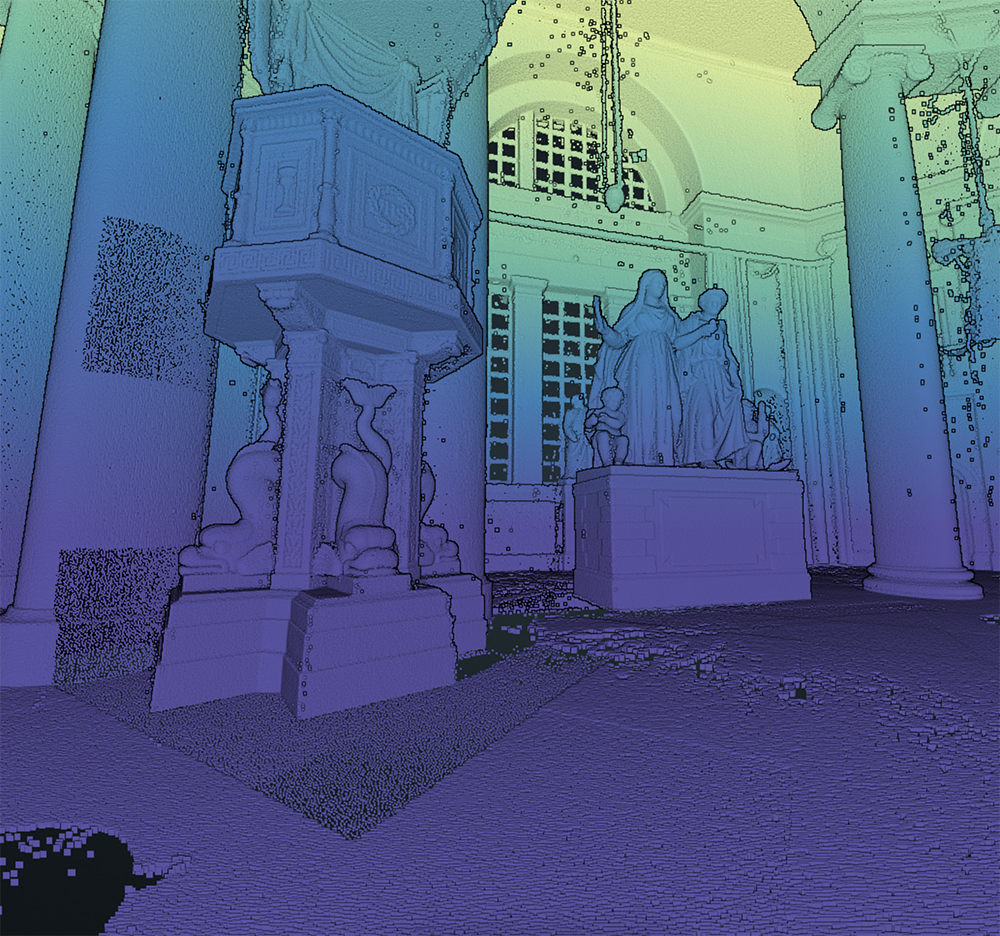
By using the open source online viewer, you can view the complete point cloud on-the-fly in your web browser. It also works on mobile platforms.
FAQ
Here are common question regarding our work:
Can i render lighting with point clouds?
No… This is the thing with point clouds. Think of it as a 3D X-Ray of the Venue.
It needs to be converted to meshes. This is very time consuming and expensive process. There are currently no automated way to do it. Therefore we do not offer mesh creation.
By offerting just the point cloud to the customers, we believe the most effective parts of the data will be used and it is up to you what is critical for the project.
What is a point cloud?
A point cloud is a large collection of data points in a 3D space. Each point represents a specific location in space and may include additional information, such as color or intensity. Point clouds are generated by 3D scanning technologies like laser spatial scanning, LiDAR, photogrammetry, or depth cameras.
In this case, think of it as a LOT of points made from a simple handheld laser distance measurer.
What is spatial 3D Scanning?
Spatial 3D scanning is a technology that captures precise digital representations of physical spaces, objects, or environments. It uses advanced laser sensors and software to create high-resolution and very accurate 3D point clouds, which can be used for planning, design, and visualization of complex objects digitally.
It is basically a machine that rotates very fast and captures a lot of data from a laser.
How accurate is 3D spatial scanning
It varies depending on the size and time needed for the desired project. It can range from 0.5mm to 10mm.
A longer scan-time usually gives a better “noise free” result.
What equipment is needed for spatial 3D scanning?
The process typically requires a 3D spatial scanner and software to process all the data.
We have all this expertise, knowledge and most up to date high-end gear to make this happen for you.
What is the range of the scanner?
Range: 0.3 – 250m.
Speed: 23sec – 6min per “scan station”.
Up to 2.187 million pts/sec
What Softwares work good with point clouds?
Some of the popular softwares for the entertainment industry are: Vectorworks, Sketchup (Windows), Autocad.
How is 3D scanning used in the entertainment industry?
3D scanning is widely used in live event planning, set design, film production, and virtual experiences. It helps create detailed venue layouts, custom set pieces, digital twins for AR/VR applications, and more. This technology enables teams to streamline workflows, reduce errors, and enhance creativity.
It can not only be used to scan venues, but also copy object from the real world that the user can re-create digitally or in real life.
Some benefits are:
• Accurate venue maapping: Ensures equipment and stage elements fit perfectly into the space.
• Faster setup and planning: Reduces time spent on manual measurements and adjustments.
• Improved visualization: Enables teams to preview setups and troubleshoot issues before production begins.
Can 3D scanning improve collaboration?
Yes!
3D scanning creates a detailed point cloud of spaces that multiple teams can access. Lighting designers, set builders, directors, and technicians can all work from the same real-world-data and discuss around certain areas easier, reducing miscommunication and ensuring everyone is aligned on the project vision.
Is 3D scanning cost-effective?
Absolutely. By minimizing errors, reducing rework, and optimizing resource allocation, 3D scanning saves both time and money. It eliminates the profligate 😉 use of materials and labor often associated with traditional methods, making it a smart investment for entertainment productions. It has been used for many years in the construction industry to eliminate any issues before it happens.
How does 3D scanning enable creativity?
With precise 3D models of venues, creatives can experiment freely, designing custom set pieces, projecting visuals, or integrating AR/VR elements without worrying about compatibility issues. It allows teams to push boundaries and create truly immersive experiences with real-life-objects.
Can 3D scanning support sustainable production?
Yes! By reducing waste through accurate planning and virtual testing, 3D scanning promotes sustainability. It helps eliminate unnecessary material use and minimizes transportation needs by allowing remote collaboration.